Horizontal Ribbon Mixer Structure Working Principle and Applications
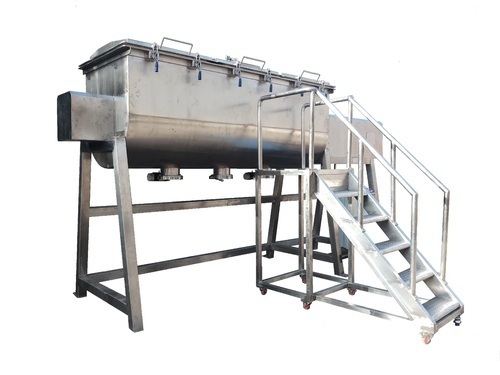
Horizontal Ribbon Mixer Structure Working Principle and Applications
Mixing is a fundamental process in many industrial sectors, essential for ensuring product consistency, quality, and uniformity. Among various mixing technologies, the Horizontal Ribbon Mixer is highly regarded for its efficiency, versatility, and ability to handle a wide range of materials. Its robust design and unique mixing mechanism make it indispensable in industries like pharmaceuticals, chemicals, food processing, construction, and plastics.
Structure of Horizontal Ribbon Mixer
The horizontal ribbon mixer consists primarily of the following components:
U-shaped Mixing Tank:
The core of the mixer is a horizontal, U-shaped cylindrical vessel. This shape reduces resistance to material movement and provides an ideal environment for mixing powders, semi-wet materials, and viscous substances.Dual-layer Spiral Ribbon Blades:
Mounted on a central shaft, the mixer uses two layers of spiral ribbons—an inner and an outer ribbon. These ribbons work in opposite directions to move the material both axially and radially within the tank. The inner ribbon pushes material from the center outward toward both ends of the vessel, while the outer ribbon moves material from the ends back toward the center, creating a convective mixing environment.Main Shaft and Transmission System:
The spiral ribbons are attached to a horizontal shaft, which is driven by a motor and gearbox. This system ensures controlled rotation speed and torque to optimize mixing effectiveness.Discharge Mechanism:
Located at the bottom of the tank, the discharge outlet typically features a large open door for powdery materials or a butterfly valve (manual or pneumatic) for semi-liquid or sticky materials. This design allows for fast unloading with minimal residual material.Optional Jacket for Temperature Control:
For materials requiring temperature regulation, the tank can be jacketed. Heating methods include electric or thermal oil heating, while cooling is generally done by circulating water through the jacket.Support Frame and Safety Features:
The entire assembly is mounted on a stable frame. Safety devices like limit switches on the lid and emergency stop buttons ensure safe operation.
Working Principle of Horizontal Ribbon Mixer
The horizontal ribbon mixer operates on the principle of counter-current convective mixing driven by the dual-layer spiral ribbons. Here is a detailed explanation:
Counter-rotating Spiral Ribbons:
When the motor starts, the main shaft rotates the ribbons inside the tank. The inner ribbon moves materials from the center outward toward both ends of the mixer, while the outer ribbon simultaneously pushes material from the ends inward toward the center.Convective Mixing:
This opposing movement creates a vigorous convective flow inside the tank. Material is continuously lifted, folded, and circulated, producing a vortex-like motion. This ensures that particles and ingredients are thoroughly blended in a relatively short time.Axial and Radial Material Movement:
The horizontal ribbon mixer’s design promotes both axial movement (along the length of the tank) and radial movement (across the tank’s cross-section), ensuring homogeneity throughout the batch.Efficient Mixing in Short Time:
Due to the spiral ribbons’ geometry and rotation speed, the mixer achieves uniform mixing rapidly. Typical batch mixing times range between 5 and 15 minutes, depending on material properties and batch size.Material Lifting and Rolling:
The ribbons gently lift the material and cause it to roll within the vessel. This gentle action prevents material degradation, especially important when mixing fragile or heat-sensitive products.Prevention of Dead Zones:
The outer ribbon’s spiral design, combined with the rotation direction, ensures there are no dead corners where material could stagnate, thus guaranteeing consistent quality.
Features and Advantages of Horizontal Ribbon Mixer
The horizontal ribbon mixer offers several key features that make it a preferred choice in many industries:
High Mixing Efficiency and Uniformity:
The counter-current ribbon motion ensures excellent mixing uniformity. Ratios of 1:10,000 can be achieved, making it suitable for sensitive formulations where precise ingredient distribution is crucial.Low Energy Consumption:
Due to the optimized design of ribbons and low friction in the U-shaped trough, the mixer operates efficiently with relatively low power input.Large Loading Capacity:
Typically, the mixer is loaded to 40%-70% of its total volume, balancing mixing efficiency and operational safety.Wide Material Compatibility:
It can handle dry powders, powder-liquid mixtures, pastes, and viscous materials. This versatility allows it to be used in pharmaceuticals, food, chemicals, plastics, ceramics, coatings, construction materials, and more.Temperature Control Capability:
The jacket option allows precise temperature regulation through heating or cooling, essential for materials that require controlled reaction or drying conditions.Ease of Discharge and Cleaning:
Large discharge ports reduce residual waste and facilitate easy cleaning, supporting rapid batch turnover.Low Pollution and Crushing:
The gentle ribbon motion minimizes material damage and dust generation, maintaining product integrity.Compact and Space-saving Design:
The horizontal layout and optimized footprint make it suitable for limited-space production areas.
Applications of Horizontal Ribbon Mixer
Thanks to its versatility, the horizontal ribbon mixer finds applications in a broad spectrum of industries:
Pharmaceutical Industry:
Used for blending active ingredients and excipients, especially for tablets, capsules, and powders requiring precise dosage uniformity.Food Industry:
Mixing flour, spices, dry ingredients, dough, or paste-like food substances. Its gentle action prevents damage to delicate components.Chemical Industry:
For pigments, fertilizers, detergents, resin powders, and many other powdered chemical formulations.Plastics and Polymers:
Mixing plastic powders with additives, colorants, or fillers before extrusion or molding.Construction Materials:
Preparation of putty, mortar, dry mix concrete, coatings, and real stone paints.Cosmetics:
Production of powders, foundation bases, and bath salts.Agriculture:
Mixing animal feed, pesticides, and soil conditioners.Others:
Applications in ceramics, inks, pigments, and many specialty materials.
Technical Considerations in Horizontal Ribbon Mixer Design
Blade Design:
Ribbon blades are typically manufactured as double or triple layers, improving mixing thoroughness.Material of Construction:
Commonly stainless steel (304 or 316) for hygienic applications; carbon steel or coated steel for general purposes.Mixing Speed:
Typically ranges between 20-60 RPM, adjustable based on material properties.Motor Power:
Depends on batch size and material viscosity, typically between 1kW to 30kW.Sealing and Bearings:
Proper sealing prevents contamination and dust leakage; heavy-duty bearings ensure shaft stability.Control Systems:
Modern mixers incorporate PLC-based controls for automated operation, safety interlocks, and process data logging.
Discharge and Feeding Systems
Efficient feeding and discharge systems enhance productivity:
Discharge Doors:
Large manual or pneumatic butterfly valves provide quick discharge, minimizing residue and downtime.Feeding:
Materials can be fed manually, via screw feeders, conveyor belts, or pneumatic systems.Heating/Cooling Jackets:
Integrated jackets allow thermal control during mixing.
Maintenance and Safety
Routine maintenance is essential to extend the life of a horizontal ribbon mixer:
Lubrication:
Bearings and gearbox must be lubricated as per the manufacturer’s recommendations.Inspection:
Regular checks on ribbon blades, seals, and motor systems.Cleaning:
Easy disassembly designs facilitate cleaning, critical for food and pharmaceutical use.
Safety features include:
Emergency stop buttons
Lid interlock switches
Overload protection for motors
The Horizontal Ribbon Mixer stands as a highly effective and versatile mixing solution across multiple industries. Its carefully engineered structure and unique working principle enable high uniformity, efficient mixing, and adaptability to a broad range of materials, from powders to viscous pastes.
With proper design, customization, and maintenance, horizontal ribbon mixers deliver consistent product quality and optimized production efficiency, making them a valuable asset in modern industrial manufacturing.