
V-blender machine is a commonly used equipment in powder processing, widely used in pharmaceutical, food processing, chemical, and other industries. So, what is the definition of a v blender machine? How does it work? What are its advantages and disadvantages? Through this guide, you will have a comprehensive understanding of the various functions of v shape blender and its applications.
what is a v blender?
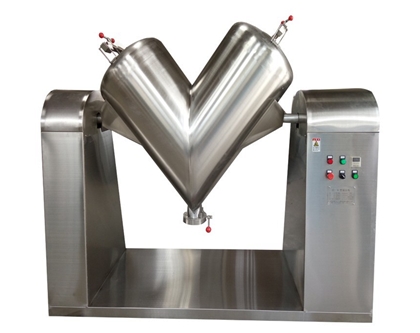
A “V blender” is a mixing machine for blending uniformly dry powders and granules. It features a V-shaped vessel, created by two interconnected cylindrical shells, which rotate to tumble and mix different materials through diffusion. Also referred to as a “v type mixer” or “V cone blender,” it is widely used in pharmaceuticals, food processing, chemicals, and other industries.
V blender Common Processes
Use the interaction of mechanical external force and material gravity to mix two or more materials evenly. This process applies to mixing, depolymerizing, drying, and liquid spraying materials such as powders and particles.
- Mixing: Evenly blend different dispersed systems to prepare new materials.
- Depolymerization: Break up agglomerated or agglomerated materials.
- Drying: Vaporize and remove liquids such as water or solvents in the material by heating.
- Liquid spraying: Evenly add an appropriate amount of water, solvent, or solution to the material.
v blender Design and Structures
Before we explore the V blender mixer working principle in detail, we will use the following two structural design drawings to help you understand the various components of the equipment more intuitively and concisely.
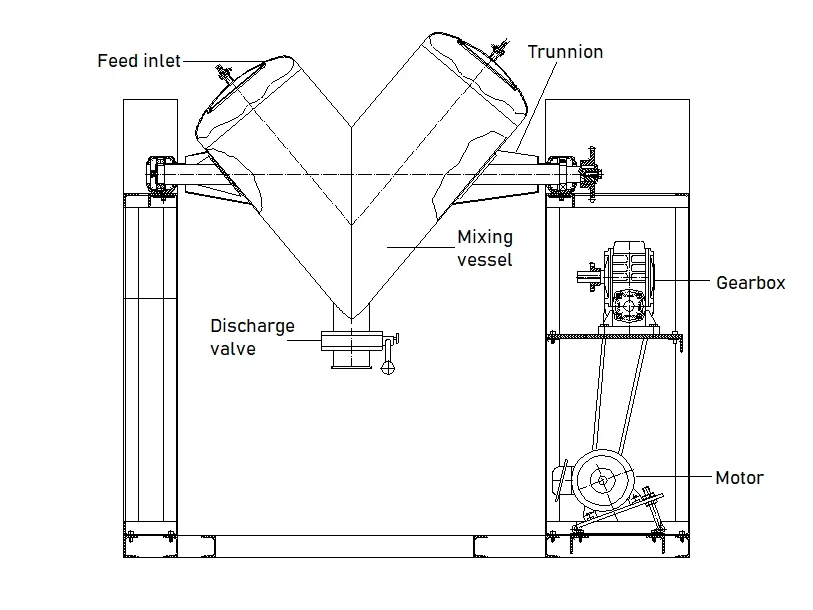
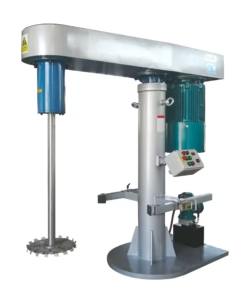
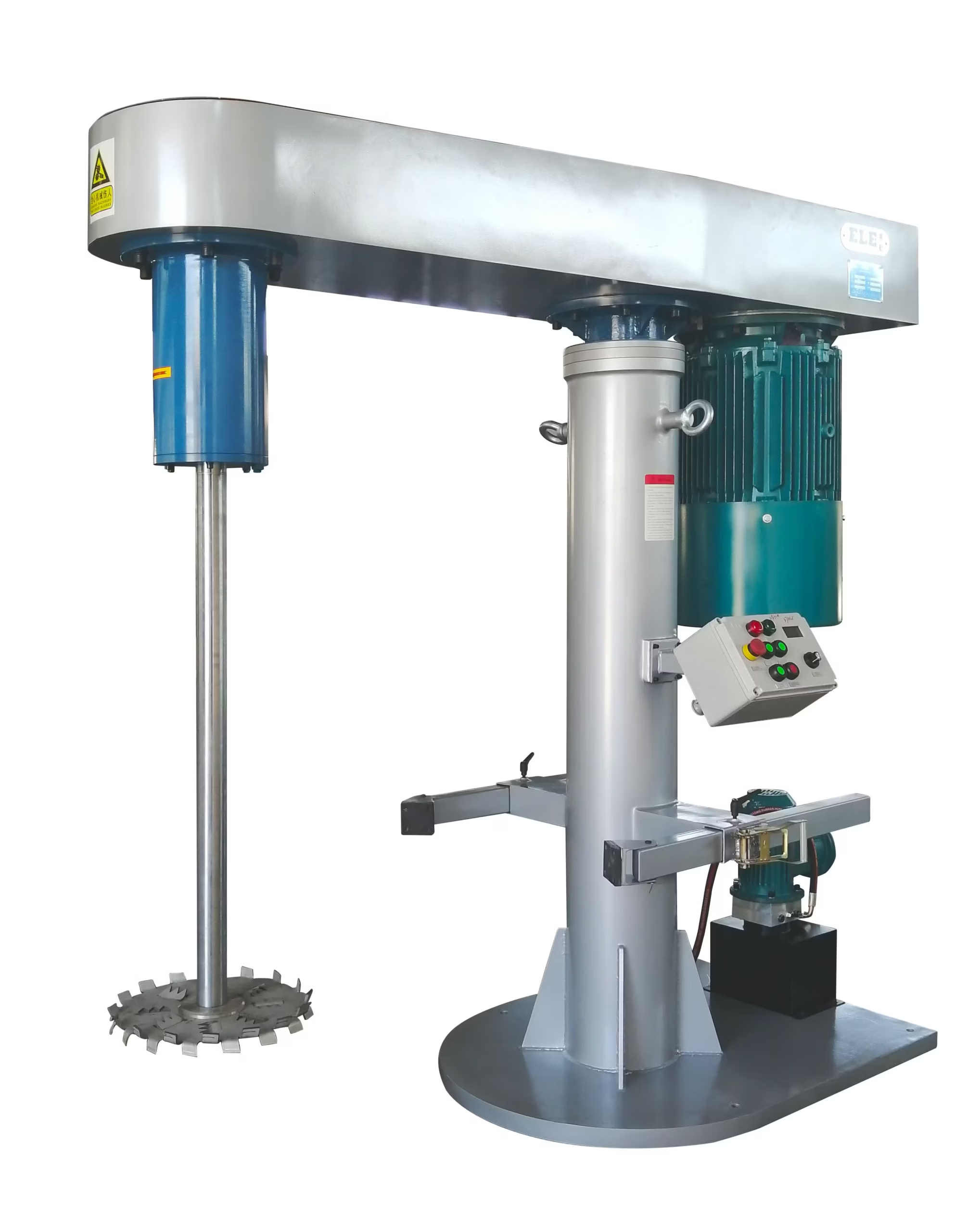
The main difference between the two images is the design of the mixing container. In the image below, there is a component that passes through the container, called the intensifier bar. This component plays a key role in improving the mixing efficiency, which we will analyze in detail later.
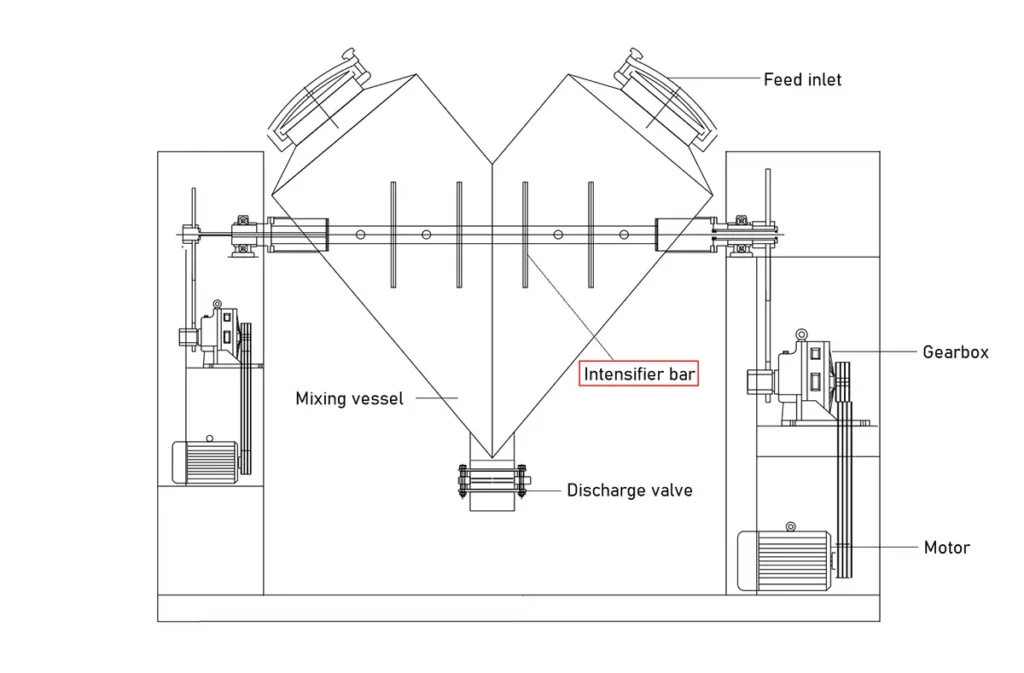
V Blender Parts
The V-type mixer consists of a V-shaped barrel, a drive motor, a reducer, bearings, a transmission shaft, an electrical control system, a frame and other auxiliary components. The following are the functional features of several main components:
V-shaped barrel
It consists of two inclined cylindrical shells, forming a “V”-shaped structure. Make the material tumble evenly during the mixing process to achieve efficient mixing.
Drive motor
Provide sufficient power to drive the rotation of the mixer to ensure the stable operation of the machine.
Reducer
It is used to reduce the motor speed to ensure that the mixer works within the optimal speed range, thereby improving the mixing efficiency and avoiding excessive energy consumption.
Drive shaft
Transmits the power generated by the motor to the mixing barrel to ensure that the materials can be evenly mixed.
Electronic control system
Controls the operating speed, time, and start/stop operation of the mixer, and has overload protection and fault diagnosis functions.
Auxiliary components
Includes reinforcement rods, discharge ports, observation windows, etc. V-type mixers can also be customized according to specific needs to adapt to a wider range of mixing applications. Custom options include: heating and cooling jackets, vacuum drying systems, explosion-proof motors and controls, and other specialized components.
V blender working principle
The principle of a V-cone mixer is very simple. The V-type mixer is mainly used to mix dry powder and granular materials. Its structure consists of two inclined cylindrical shells connected in a “V” shape. Through mechanical drive, the powder in the shell is repeatedly tumbled during the continuous rotation process, so that the material is continuously dispersed and mixed to achieve a uniform mixing effect. Normally, the mixing cycle time is about 15 minutes, but depending on the nature of the mixed material, the mixing time may be shorter. To improve the mixing efficiency, the V-type mixer can also be equipped with a booster rod to assist in the mixing and crushing of the material.
Advantages and Disadvantages of V-type blender
When compared with other mixing equipment (such as conical twin screw mixer), a V-type blender has unique advantages and limitations. Its working principle is based on gravity convection diffusion mixing, which is particularly suitable for mixing free-flowing solids or low-viscosity liquids. The following is an analysis of the advantages and disadvantages of the V-type mixer:
Advantages:
- The advantages of the V-type blender can be summarized as follows:
- Unique structure: The mixing barrel of the V-type blender mixer has a unique structure. The barrel is cut at a 40-degree angle and then combined into a mixing barrel of unequal height to improve the mixing effect.
- Efficient mixing: The equipment has high mixing efficiency and no dead angle, ensuring uniform mixing of materials.
- Various materials: The barrel and bracket can be made of Q235 carbon steel or SUS304 stainless steel. For special materials, plastic barrels can also be used to meet the mixing needs of various materials.
- Polishing and beautiful: The inner and outer walls are polished, the surface is smooth, the material adhesion is reduced, the mixing quality is guaranteed, and the appearance is beautiful.
- Stepless speed regulation: The electromagnetic speed regulating motor is adopted, and the speed can be steplessly adjusted between 2-15 rpm to meet different operating requirements.
- Safety protection: The reducer with self-locking function and the thermal relay protect the motor from overload to ensure the safe operation of the equipment.
- Timing control: The mixing time is controlled by time relays, which is easy to operate.
Vacuum feeding: It can be equipped with a W-type reciprocating vacuum pump or water ring vacuum pump to achieve vacuum feeding and improve working conditions.
Forced stirring: For finer powders, agglomerates or materials containing a certain amount of water, a forced stirring device can be set to shorten the mixing time and improve the mixing uniformity.
Disadvantages:
- Insufficient mixing: At the microscopic level, the powders may be difficult to mix completely and evenly, resulting in uneven distribution of small particles.
- Ultra fine powders are difficult to mix: For ultra fine powders or ultralight powders, the mixing effect is poor and it is difficult to fully integrate into the main material.
- Destruction of powder morphology: During the mixing process, the original shape of the powder may be destroyed due to the action of throwing and smashing motion.