Day: January 24, 2019

Essential Oil Steam Distillation Plant

Essential Oil Distillers is suitable for the extraction of various flowers and leaves which contain essential oil. It adopts water vapor distillation apparatus for water distillation method and water proof distillation method, so the extraction of plant volatile component is effectively, this equipment is suitable for enterprises to set up production near the plant origin place.
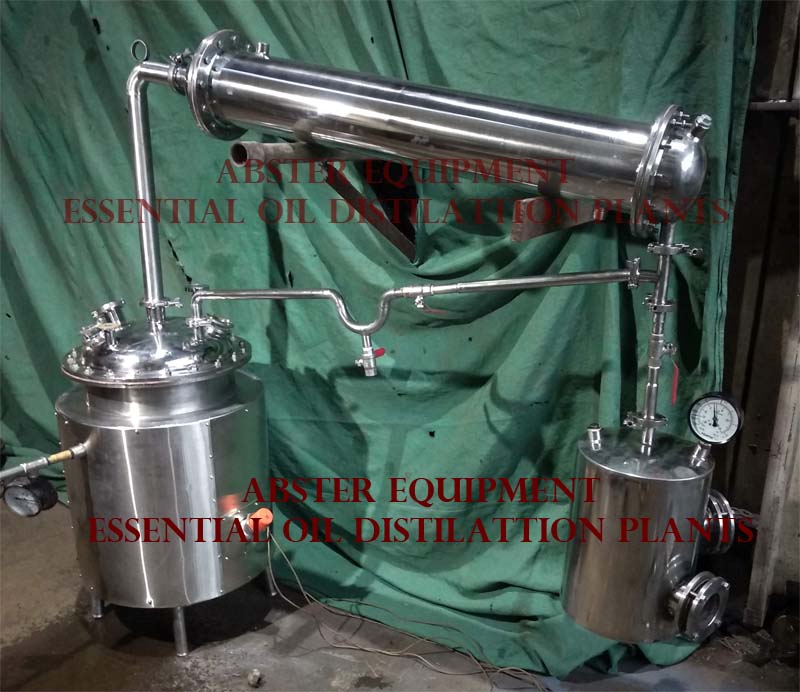
Essential Oil Distillation Plants

The equipment is new, multi functional and multipurpose plant essential oil extraction unit. the equipment can collect the plant essential oil, aromatic plants, and other effective ingredients efficiently.

Features and advantage:
Oil extraction rate is very high
Adapt to various heating methods
Machine structure can be done according to customer requirements
This equipment is made of SUS304 stainless steel with special frame.
It has Special condenser design which can extract the oil efficiently.

Essential oil distiller working process and working principle:
Essential Oil Distillation Plants
(a) water vapor water distillation
1) of the material into the extracting tank distillation in the basket, basket distillation for orifice plate structure, distillation blue can be on-demand materials, such as fresh flowers and plants is placed at the bottom of the retort to join a certain percentage of pure water, water not overflow the distillation blue lowest place.General material liquid ratio of 1:3 is best.(can also add a moderate amount of additives according to the technical requirement).

2) open the extraction distillation tank heating system, make the distilled water heated to set temperature (generally for water boiling temperature of 100 degrees Celsius), extract the normal start.When distilled water temperature reached 70 degrees Celsius, open condensate valve. If equipped with ice water unit need to be water temperature reached 50 degrees Celsius is open cold water unit, and maintain stability of the condenser water flow rate.

3) distillation extraction began, oil-water separator bottom by glass pipe dynamically observe essential oil extraction effect.

4) distillation extraction began, condenser condensate must be open.General plant essential oil extraction time is longer, mezzanine boiler temperature can be set to 120 ~ 130 degrees Celsius, distillation tank temperature setting to 102 ~ 105 degrees.To keep the distillation tank water boiling.Ensure that the steam is enough.
Operation experience: before distillation temperature reach the set value, can be set higher interlayer boiler temperature, such as 150 degrees, let the temperature rise more quickly, when the temperature difference 10 degrees or so close to the set value, the temperature of interlining boiler to normal, such as 115 degrees.

5) general distillation extraction time is 3 ~ 5 hours, (according to the roses, for example, 3 hours yield efficiency 84.783%, yield efficiency 95.652%) 5 hours after the distillation extraction, shut off the distillation extraction tank heating system, etc. After 20 minutes in the closed cooling water.

6) condenser opens in the extraction tank temperature to 80 ° C, while ensuring the condenser top open open.

7) condenser in normal work, the upper openings with water vapor.If there are any vapor emitted that condensed water temperature too high or low condensed water.If there are any conditions, can use cold water cycle refrigeration unit.It can better improve the effect of the extraction of volatile oil.
(note: if the API to powder or tiny particles that can use API into the first fine stainless steel wire mesh paved distillation in the blue, after extraction is advantageous for the liquid out.)
(2) water vapor distilled water
1) the flowers and plants such as the material directly into the distillation extraction tank, the bottom of the retort adding suitable amount of pure water, half of the volume of water not overflow the retort, generally for 1/3 of the tanks as well.(can also add a moderate amount of additives according to process requirements, generally increase the concentration of 2.5% concentration of sodium chloride aqueous solution to distillation, obvious effect).
2) open the extraction distillation tank heating system, make the distilled water heated to set temperature (generally for water boiling temperature of 100 degrees Celsius), extract the normal start.When distilled water boiling on condensed water device, guide the steam entering the condenser, cooler, oil water separator.Condensate can be opened in advance Behind (like water distillation operation.)

We are selling below models:

Models Description Price
ABFEO100 100L
ABFEO200 200L
ABFEO300 300L
ABFEO400 400L
ABFEO500 500L

ABFEO1000

It can put 120kg flower into the EO1000
Leaves 150kg into EO 1000,
L W H : 6000X2300X 3700 MM
                     

ABFEO2000

it can put 240kg flower into EO2000,
300kg leaves into EO 2000,
L W H : 5800X2400X3700MM

ABFEO3000

It can put 360kg flower into EO 3000,
450kg leaves into EO3000,
L W H :6200X2600X5200MM
ABFEO 4000  4000L
ABFEO 5000 5000L
ABFEO6000 6000L

What is Distillation and How Does it Work?

What is Distillation and How Does it Work?

Distillation is the art of removing these precious chemicals via high pressure steam or mix of steam and boiling water. To begin distillation, the appropriate amount of plant material is packed into a hopper. The canister is sealed to create atmospheric pressure. The correct amount of water is added for that batch and then heated. Steam is created by either boiling the water in the hopper or injecting steam and forced through the pressurized hopper or vessel containing the plants. The heat of the steam ruptures the molecules in the plant and carries the particles of essential oil and other constituents through a cooling system into another container. When the steam passes through the cooling unit, it reverts back to water, where it separates from the essential oil  because of their different densities. Essential oils are lighter than water and will therefore float on top. Water soluble chemicals will stay mixed with water creating extracts or hydrosols. Following is a brief description of three basic methods.

Water Distillation
For this method, the plant material is submerged in water. The water is then heated to boiling point  During this process, there is direct contact between boiling water and plant material.  All parts of the plant material must be kept moving by the motion of boiling water. This method is used with plant material that can’t be easily be broken down with steam or water and steam distillation such as cinnamon bark.

Water and Steam Distillation
Water and steam distillation methods employ the same basic equipment as water distillers. The fundamental difference is the plant material is set on a perforated grill above the water as opposed to being immersed in the water. This method is more energy efficient as the essential oil is produced at a much faster rate with higher yields. Thermal degradation is reduced as well. Many oils which contain significant aldehydes such as lemongrass are still produced this way.

Direct Steam Distillation

This type of distiller is designed quite differently than water and water steam distillers. There is no water in the hopper with the plant material. Steam is generated in a separate boiler chamber and then injected into the plant material from outside the still. The plant material is placed on a perforated grid above the steam inlet. A real advantage of steam generation is that the amount of steam can be readily controlled. Because steam is generated in a satellite boiler, the plant material can be heated at lower temperatures of 90- 100° C reducing thermal degradation.  A drawback to steam distillation is the much higher capital expenditure on such equipment.  Many mass produced essential oils such as rosemary,  lavender and eucalyptus, are produced this way

Do All Plants Produce Essential Oils?

No they don’t.  In fact of the hundreds of thousands of plant species, only a few thousand may be capable of producing an essential oil.  Therefore, when companies state that essential oils are the “life blood of a plant” this is not true.

Can Any Plant be Distilled?

Theoretically, you can distill any plant material, however, you may not like the results. Distillation is reserved for plants which are capable of producing an essential oil and not easily damaged by heat.  Jasmine is one of the most coveted aromatic oils in the world but it can’t be distilled without serious thermal degradation which destroys the aromatic properties that make it so precious.

Given that it takes thousands of pounds of petals harvested during a few weeks of the year and a few hours of those days to produce even a few ounces of oil through other effective methods of extraction, it make no economical sense to waste any petals on distillation to produce an inferior product.

Are Plants Which Do Not Produce Essential Oil Distilled?

Some plants such as witch hazel or sweetgrass which don’t produce an essential oil are distilled because their water is coveted for aromatic, spiritual and medicinal properties.  Others can be concentrated to create water soluble  extracts such as cucumber or green tea.

Are all Plants Distilled in the Same Amount of Time?

The amount of time for distillation per batch of plant material has a vast range dependent on the quality of oil required and the plant material itself. This is where expertise of specific plants is necessary to produce a quality oil or one to specific industry standards. For example, lavender can be distilled in one to two hours depending on batch size, whereas clove or cinnamon take much longer.

Different distillation times of a particular plant will create different grades.  Ylang Ylang, a prized aromatic oil, has several grades (extra, 1 , 2, 3 and dark).  The grades are indicative of distillation time with “extra”  and 1 being the shortest time, which produces the lowest yield, best aromatic properties and highest price.  The perfume industry purchases most of these grades leaving very little for public consumption.  Grade 3 and dark, produce more oil because of longer distillation time, but is not considered fragrantly appealing so the price is dramatically reduced.  These grades are usually destined for industrial purpose.

There is also no such thing as 2nd or 3rd distillation.  A batch of plant material is distilled once and then discarded.  Most often the plant material is spread back in the fields to provide nutrients and act as ground cover to reduce weeds.

Can an Essential Oil or Liquid Plant Extract be Distilled?   

Yes it can.  This is most often done to further process an oil to remove impurities or reduce high amounts of hazardous chemicals.  Peppermint which may contain 50-80% menthol on initial distillation can be re distilled to reduce levels  under 40% content, making the oil more aromatic and safer to use.  The menthol crystals that are removed are usually sold to pharmaceutical companies.  Bitter orange which is initially expeller pressed, is then distilled to remove water and other impurities.  many citrus oils are extracted via cold pressing but then distilled to remove photo sensitizing chemicals or isolate other aroma chemicals.  This process is called “Folding”

“This article was written by Sandy Powell, copyright Nascent Naturals Inc. ©. All Rights Reserved. www.nascentnaturals.com